

Target Keywords: *office reinstatement Singapore, reinstatement contractor Singapore, commercial reinstatement contractor Singapore, end of lease reinstatement Singapore, office reinstatement works Singapore, direct contractor for office renovation Singapore, BCA registered renovation contractor Singapore, BizSAFE renovation contractor Singapore*
—
Introduction
At the conclusion of any commercial lease in Singapore—whether for a prime Grade-A office in the Central Business District (CBD), a retail space in a suburban shopping mall, or a light industrial warehouse in Jurong—tenants face a strict legal obligation: reinstatement.
Reinstatement is the process of restoring a leased commercial property back to its original “bare-shell” or landlord-approved condition before handing back the keys. Failing to manage this process correctly can lead to forfeited rental deposits, costly project delays, and legal disputes with major corporate landlords.
For operations managers, HR leads, and business owners, managing a commercial reinstatement is often a high-pressure race against the lease expiry date.
This comprehensive guide breaks down everything you need to know about commercial reinstatement in Singapore. From understanding the standard scope of works and navigating landlord MCST approvals to managing Fire Safety and Shelter Department (FSSD) compliance, we provide actionable strategies to execute a flawless handover while saving up to 30% by working directly with a credentialed contractor.
—
1. What is Commercial Reinstatement? (The Standard Scope of Works)
Many tenants assume that reinstatement simply means moving out their office furniture and giving the walls a fresh coat of paint. In reality, landlords expect the space to be returned in a condition that is ready for the next tenant to fit out.
Depending on the specific covenants in your tenancy agreement, the standard scope of reinstatement works in Singapore typically includes:
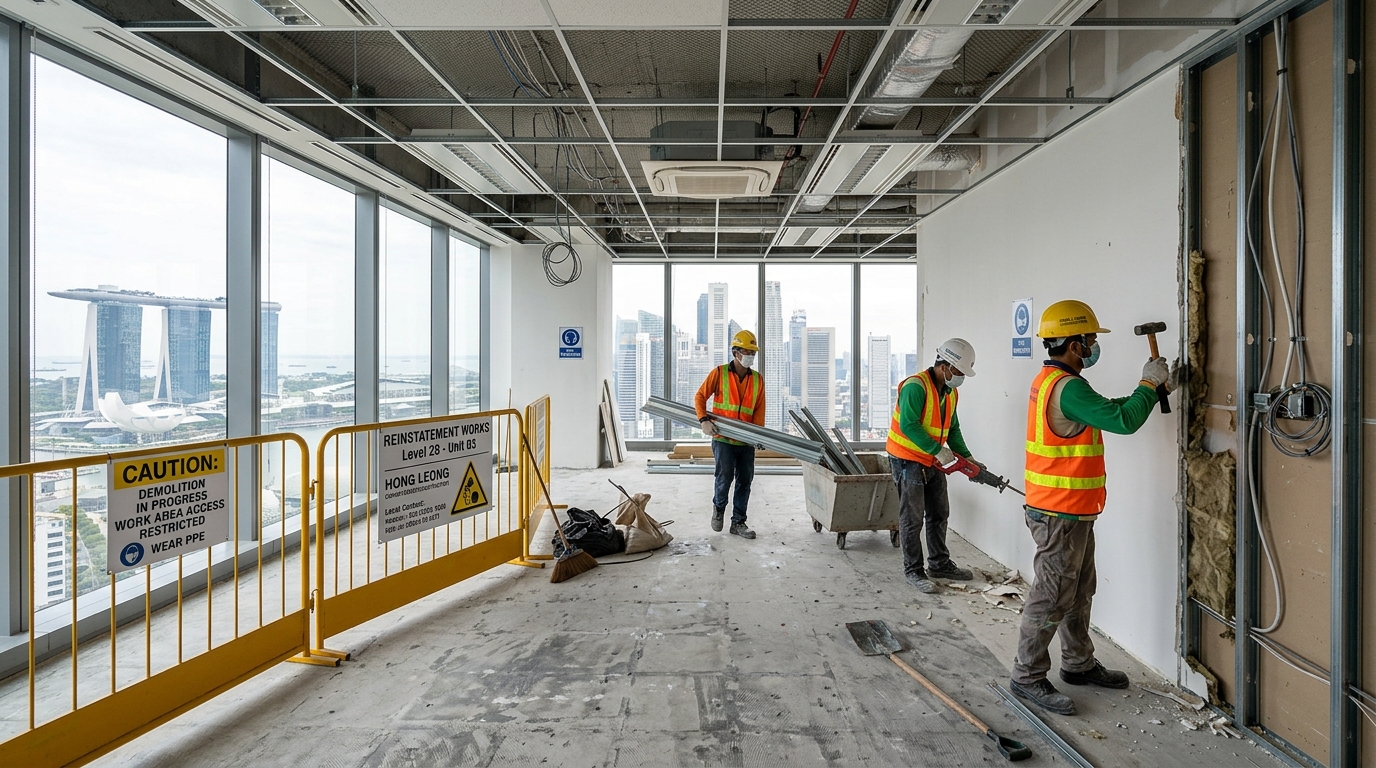
A. Demolition and Partition Removal
- Drywall Partitions: Dismantling all gypsum board drywalls used for private offices, meeting rooms, and printing areas.
- Glass Partitions: Safely removing glass panels, frames, and custom doors from conference zones and executive suites.
- Built-in Carpentry: Demolishing reception counters, built-in pantries, storage cabinets, and feature walls.
- Masonry Hacking: Removing brick walls, elevated floor platforms, or custom concrete partitions.
B. Removal of Floor Finishes
- Carpet and Vinyl Tiles: Scraping off carpet tiles, glue residues, and self-adhesive luxury vinyl tiles (LVT).
- Cement Screed Hacking: Hacking away custom tiles, wood decking, or floor toppings to expose the structural concrete subfloor.
- Slab Grinding: Smoothing the subfloor to ensure it meets the flat-floor specifications required by the building’s management.
C. Mechanical, Electrical, and Plumbing (M&E) Restoration
This is often the most complex and heavily audited part of any reinstatement project:
- Electrical Cable Handovers: Removing all secondary wiring, floor trunking, network LAN cables, and custom power outlets installed during the tenancy.
- DB Box Restoration: Rewiring the main distribution board back to the building’s original single-phase or three-phase baseline layout.
- Air-Conditioning (HVAC) Termination: Removing secondary FCU (Fan Coil Unit) units, custom ductwork, and returning mechanical ventilation diffusers to their original grid layout.
- Plumbing Restoration: Terminating plumbing pipes installed for private pantries or executive toilets, sealing wet points, and ensuring waterproofing remains intact.
D. Ceiling and Painting Works
- Ceiling Grid Restoration: Replacing missing or damaged acoustic ceiling boards and repairing grid systems.
- Removing Exposed Ceilings: Restoring standard false ceilings if the tenant had implemented an industrial-style “open ceiling” layout.
- Painting: Repainting all perimeter walls, structural columns, and drywalls back to the landlord-approved baseline white color (usually utilizing low-VOC emulsion paint).
—
2. Navigating Landlord Expectations & MCST Approvals
Every commercial building in Singapore is managed either by a private corporate landlord (e.g., CapitaLand, Mapletree, CDL, Suntec REIT) or a management corporation strata title (MCST). To begin reinstatement works, you cannot simply hire a contractor and start hacking. You must obtain formal approval.
The MCST Approval Pipeline:
Step 1: The Pre-Reinstatement Joint Site Inspection
Four to six weeks before your lease ends, schedule a joint inspection with the landlord’s building manager and your chosen reinstatement contractor. During this walkthrough, the landlord will verify:
- Which fixtures are considered base-building items (which must stay, such as primary fire sprinklers, aircon main ducts, and perimeter trunking).
- Which fixtures are tenant fit-out items (which must be completely demolished).
- The exact baseline layout plan (usually referenced from the original hand-over drawings from when you first leased the property).
Step 2: Documentation and Methods Statement
Your contractor must submit a detailed Method Statement, risk assessment documents, and architectural/engineering drawings to the building management. This documentation must outline:
- How debris will be transported out of the building without damaging public lifts and corridors.
- The exact schedule of work (specifically isolating noisy works like concrete hacking to after-office hours or weekends).
- Proof of valid Public Liability Insurance (usually minimum S$1,000,000 to S$5,000,000 depending on the building class) and Work Injury Compensation Insurance (WICA).
Step 3: Endorsements by Licensed Professionals
Major commercial properties require specialized professional endorsements before signing off on handovers:
- LEW (Licensed Electrical Worker) Endorsement: An LEW must inspect the electrical modifications, disconnect tenant power distribution safely, and issue a Single Line Diagram (SLD) certifying that the returned DB box is safe and meets SP Group standards.
- PE (Professional Engineer) Endorsement: If structural hacking, floor-loading adjustments, or heavy mezzanine removals were performed, a structural PE must certify that the building’s structural integrity remains unaffected.
—
3. FSSD Fire Safety Compliance: A Critical Handover Requirement
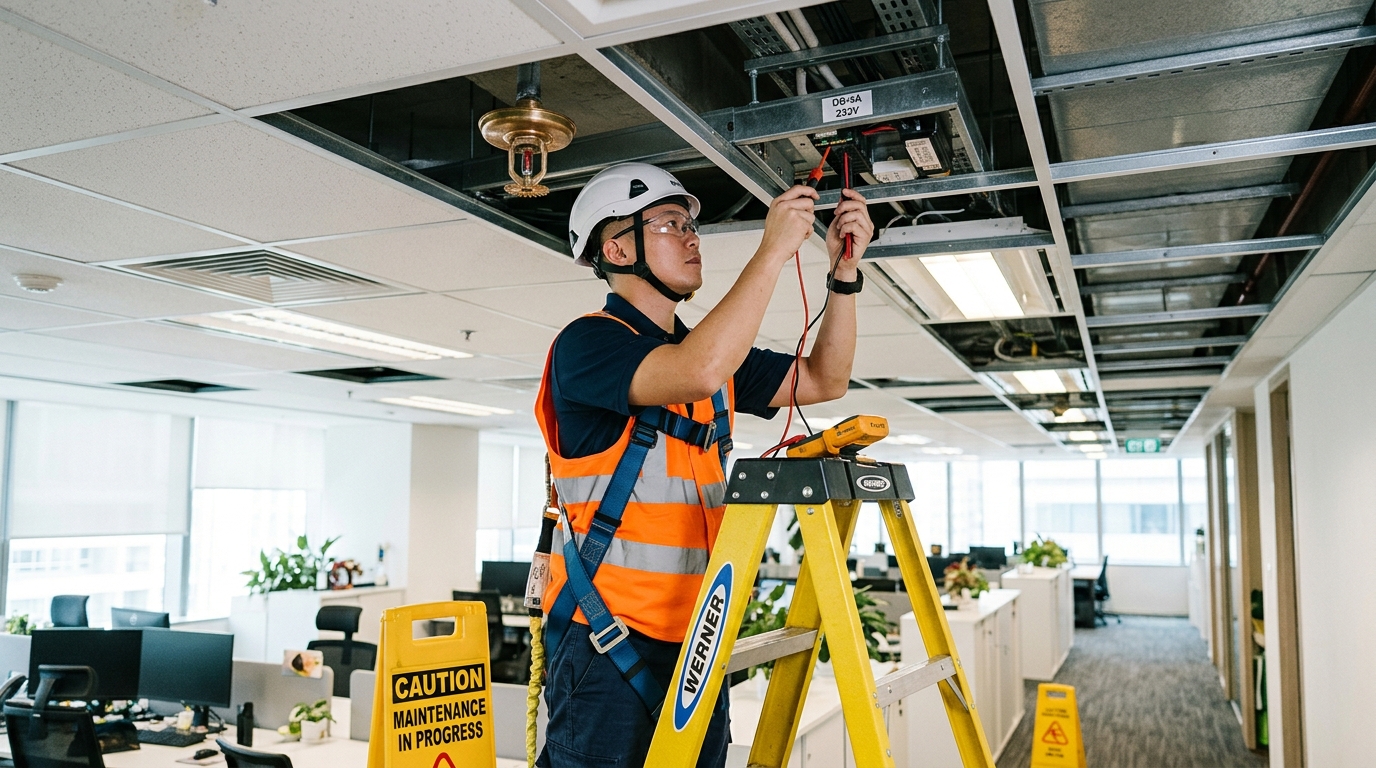
A common cause of delayed handovers and lost rental deposits in Singapore is failing to clear the Fire Safety and Shelter Department (FSSD) audit. During fitting out, tenants often move fire sprinkler heads, relocate fire exit signs, or adjust emergency lighting to suit their office layouts. During reinstatement, these must all be returned to the building’s original safety grid.
Critical Fire Safety Compliance Rules (SS 575):
1. Sprinkler Head Relocation: In Singapore, fire sprinkler systems are governed by Code of Practice SS 575. Any relocation, addition, or deletion of sprinkler heads must be done by a licensed contractor and calibrated to match the building’s main loop pressure.
2. Coverage Gaps: When partitions are removed, the resulting open space must have complete sprinkler coverage. You cannot leave “dead zones” where a sprinkler head is blocked or missing.
3. Emergency Lights and Exit Signs: Emergency exit signs, emergency battery packs, and warning systems must be restored to their default exit route paths. Exit paths must remain completely unblocked throughout the demolition process.
4. Registered Inspector (RI) Inspection: Once M&E works are completed, a Registered Inspector (RI) must conduct a physical inspection of the site to certify compliance before FSSD signs off. If the RI finds issues, the handover is rejected, and you may be charged daily penalty rents by the landlord for occupying the space past your lease term.
—
4. Commercial Reinstatement Cost Breakdown in Singapore
How much does reinstatement cost? The total budget is determined by three variables: floor area, the density of custom fit-outs, and building accessibility.
Below is a baseline cost breakdown for commercial and office reinstatements in Singapore as of 2026:
| Office/Space Classification | Floor Area (Sq Ft) | Typical Reinstatement Cost Range (SGD) | Average Cost Per Sq Ft (SGD) | Typical Demolition Challenges |
|---|---|---|---|---|
| **Small Office / Retail Shop** | < 1,500 | S$4,500 – S$15,000 | **S$3.00 – S$10.00** | Dense partitioning, custom retail storefront glass, complex shopfront signage removals. |
| **Medium Corporate Office** | 1,500 – 5,000 | S$15,000 – S$45,000 | **S$4.00 – S$9.00** | Multiple M&E zones, boardroom glass dismantling, server room cooling system decommissioning. |
| **Large Corporate Headquarters** | > 5,000 | S$45,000 – S$120,000+ | **S$4.50 – S$8.50** | Passenger lift coordination, heavy structural cabling removal, large-scale ductwork restoration. |
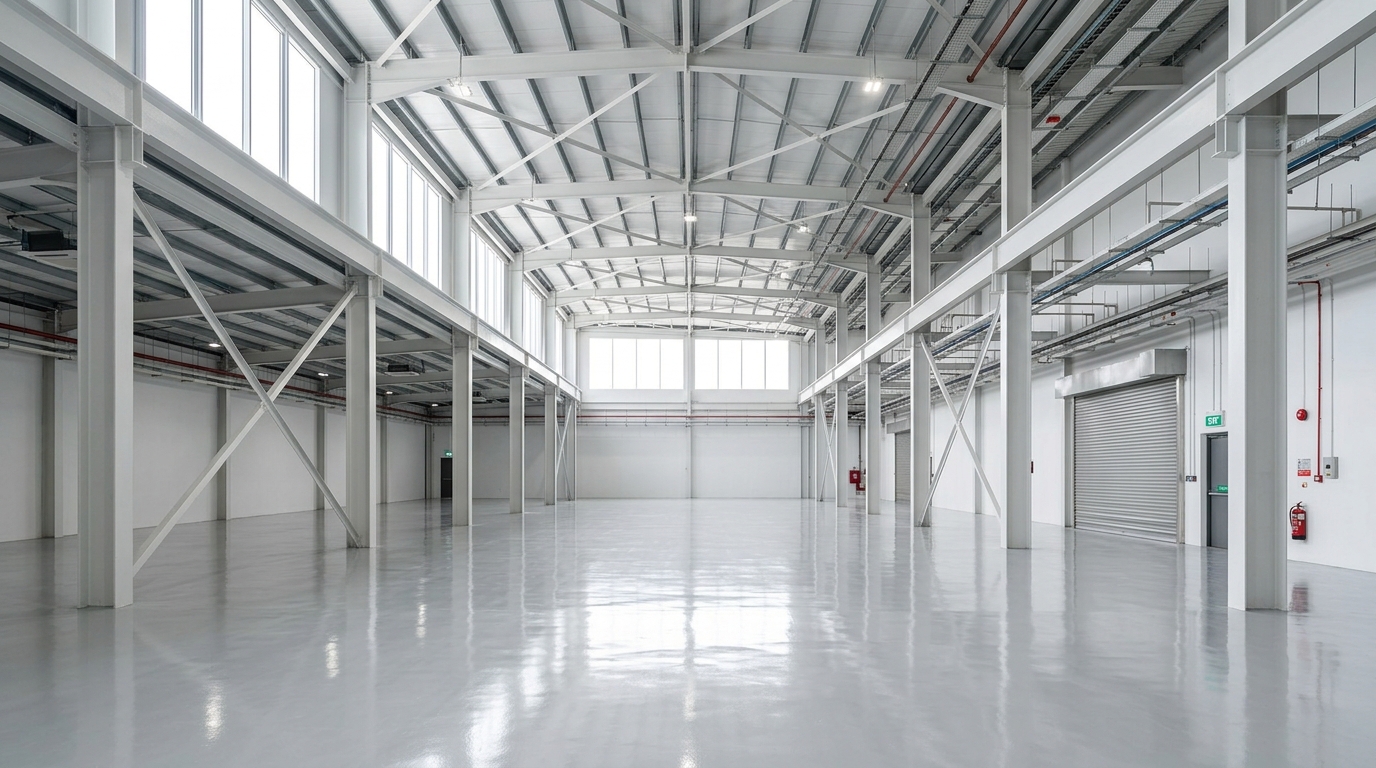
| **Light Industrial / Warehouse** | Variable | S$8,000 – S$35,000+ | **S$2.50 – S$6.00** | Mezzanine platform demolition, floor grinding, epoxy floor coatings removal, heavy steel racking hacking. |
Key Cost Drivers Explained:
- Access Constraints (Night Works): Almost all Grade-A buildings in Raffles Place, Marina Bay, and Orchard Road prohibit noisy demolition during business hours (9:00 AM to 6:00 PM). Contractors must execute works at night or during weekends, which increases labor costs due to overtime pay rates.
- The Carpentry & Glass Factor: If your office has extensive custom-built wood storage cabinets, partition walls, and double-glazed acoustic glass boards, the manual labor required to dismantle and dispose of these heavy materials is significantly higher than basic drywall spaces.
- Disposal & Dumping Fees: Singapore enforces strict environmental rules for industrial waste. Debris must be sent to NEA-approved recycling and disposal facilities. Increased public dumping fees directly impact the overall reinstatement budget.
—
5. Direct Contractor vs. ID Firm: Saving 30% on Your Reinstatement
When faced with a lease expiry, many corporate tenants automatically contact the Interior Design (ID) firm that originally built their office to handle the reinstatement. While convenient, this is the most expensive route.
Here is why working with a Direct Reinstatement Contractor like Nouvelle Workz can save your company 30% or more:
[Tenant] ➔ [ID Firm (Takes 20-30% Markup)] ➔ [Sub-Contractors (Demolition, M&E, Painter)]
Direct Contractor Route:
[Tenant] ➔ [Direct Contractor (Own Workers & Equipment)] ➔ [Direct Execution]
The Direct Contractor Advantage:
1. Eliminating Middleman Markups: ID firms rarely own demolition equipment, trucks, or employ M&E workers. They act as project coordinators, subcontracting the actual labor out and adding a 20% to 35% markup on the entire project bill. A direct contractor executes the works with in-house masonry, carpentry, and electrical teams.
2. In-House Carpentry and Masonry Assets: Reinstatement requires immediate repair of grid ceilings, flooring, and masonry. Nouvelle Workz operates its own carpentry facilities and maintains direct accounts with industrial suppliers, meaning raw material costs (gypsum, ceiling tiles, paint) are billed without third-party markups.
3. Faster Landlord Negotiation: Building managers are highly technical. When they raise questions about method statements or electrical Single Line Diagrams, dealing with an ID coordinator leads to communication delays. Dealing directly with the engineering lead of a direct contractor ensures issues are resolved on-site in minutes, avoiding delays in getting your permit to work.
—
6. Crucial Credentials: BCA Registration & BizSAFE Level 3
In Singapore, you cannot hire general laborers to execute commercial demolition. Major landlords (e.g., CapitaLand, Mapletree) will immediately deny entry to any contractor that does not possess the correct statutory safety credentials.
A. BCA Registered Contractor
The Building and Construction Authority (BCA) registers contractors based on their financial capability, track record, and technical expertise.
- Hiring a BCA Registered Contractor ensures that the company has certified professionals capable of navigating code compliance.
- Landlords use BCA registration as an initial filter; if your contractor is not registered under the appropriate BCA workhead (such as CR06 for Interior Design & Finishing Works), they will not be allowed to submit architectural drawings for MCST approval.
B. BizSAFE Level 3 Certification
BizSAFE is a national program administered by the Workplace Safety and Health (WSH) Council to promote safety in workplaces.
- BizSAFE Level 3 is the absolute minimum standard required by 95% of Singapore’s commercial buildings.
- To obtain Level 3, a contractor must undergo an independent audit of their Risk Management (RM) implementation.
- Demolition and M&E works involve high-risk tasks (working at heights, operating heavy concrete breakers, handling live electrical cabling). If a worker is injured on site and the contractor does not have BizSAFE Level 3, the tenant (your company) can face severe legal liabilities under the WSH Act. Always ask to see your contractor’s BizSAFE certificate before signing the quotation.
—
7. Step-by-Step Reinstatement Timeline (End-of-Lease Checklist)
To avoid paying double rent or facing penalty disputes with your landlord, use this timeline checklist to plan your office reinstatement:
| Timeline | Priority Focus | Checklist Actions Required |
|---|---|---|
| **T-6 Weeks** | **Strategic Planning** | * Locate your original Tenancy Agreement and handover photos. * Request original structural and M&E drawings from the building manager. * Contact a credentialed, direct contractor to conduct a site measurement. |
| **T-4 Weeks** | **Approval Phase** | * Schedule the joint walkthrough inspection with the landlord. * Finalize the scope of works and sign the contractor’s quotation. * Have your contractor submit the Method Statement and drawings to the MCST. * Pay the building’s temporary renovation deposit. |
| **T-2 Weeks** | **Demolition Phase** | * Contractor secures the Permit to Work (PTW). * Isolate and terminate live power lines safely under LEW supervision. * Safely dismantle all built-in carpentry, glass doors, and drywall partitions. * Clear out carpet tiles, floor glue, and dispose of materials. |
| **T-1 Week** | **Restoration Phase** | * Restore the air-conditioning ventilation and sprinkler systems to the base grid. * Repair grid ceilings, patch up damaged concrete floors, and paint walls white. * Conduct testing on exit signs, emergency lights, and base power outlets. |
| **Handover Day** | **Final Handover** | * Schedule the final joint site inspection with the landlord. * Perform a final walkthrough, test all base building fixtures, and sign off the handover certificate. * Request the release of your renovation deposit from the building management. |
—
8. Answer Engine Optimization (AEO): Frequently Asked Questions
As search engines evolve into AI answer engines (like ChatGPT, Gemini, and Perplexity), businesses are increasingly asking specific, direct questions online. Below are the definitive, expert-reviewed answers to the most common questions regarding Singapore commercial reinstatements:
Q1: Can I negotiate with my landlord to skip the reinstatement process?
Yes, but under strict conditions. You can negotiate a “Handover-As-Is” agreement if the incoming tenant specifically wants to keep your fit-outs (such as boardrooms, pantries, or partitions). However, you must get the landlord’s written consent, and the incoming tenant must sign a legal indemnity taking full liability for the fit-outs when their lease eventually expires. If no tenant is lined up, the landlord will almost always demand complete reinstatement.
Q2: How long does it typical take to reinstate a 2,000 sq ft office in Singapore?
For a standard 2,000 sq ft office with moderate partitioning and drywall, the physical demolition and restoration process takes 7 to 10 working days. However, you must allow an additional 7 to 14 days prior for the MCST to review and approve the paperwork, drawings, and insurance policies. We highly recommend initiating the process at least 4 weeks before your lease expires.
Q3: What happens if the reinstatement is not completed before my lease ends?
If you fail to hand over the space in bare-shell condition by the lease expiry date, you will be in breach of contract. Under standard Singapore commercial lease terms, the landlord has the right to:
1. Charge you “Holding Rent” or Liquidated Damages (often double the daily rent rate) for every day the handover is delayed.
2. Appoint their own contractor to complete the work and deduct the entire cost directly from your security deposit, often billing you at double the market rate.
Q4: Are contractors required to have public liability insurance for office reinstatement?
Yes, absolutely. Every MCST in Singapore requires the contractor to submit proof of a valid Public Liability Insurance policy before issuing a Permit to Work. The coverage must protect the building’s structure (lifts, corridors, fire sprinkler loops) from accidental damage during demolition. Standard coverage requirements range from SGD 1,000,000 to SGD 5,000,000, which a professional contractor like Nouvelle Workz provides as a standard inclusion.
Q5: Why do building managements reject certain contractors for reinstatement?
The most common reasons for rejection are:
1. The contractor lacks a BizSAFE Level 3 certificate.
2. The contractor is not registered with the BCA under appropriate workheads.
3. The contractor failed to submit a certified Single Line Diagram signed by a Licensed Electrical Worker (LEW) for DB board restoration.
4. The contractor’s Public Liability Insurance coverage value is lower than the building management’s required threshold.
—
Conclusion
Managing an end-of-lease commercial reinstatement in Singapore doesn’t have to be a stressful bottleneck. By understanding the required compliance steps, preparing a timeline at least six weeks in advance, and hiring a direct, credentialed contractor, you can bypass third-party markups and guarantee a 100% deposit return.
As a BCA Registered and BizSAFE Level 3 Certified direct contractor, Nouvelle Workz has years of experience managing complex commercial office, retail, and industrial reinstatements across Singapore. We handle the entire process—including MCST liaison, public liability insurance, LEW electrical testing, and FSSD safety compliance—delivering stress-free handovers with transparent pricing.
*Contact the team at Nouvelle Workz today for a complimentary site inspection and reinstatement assessment.*