

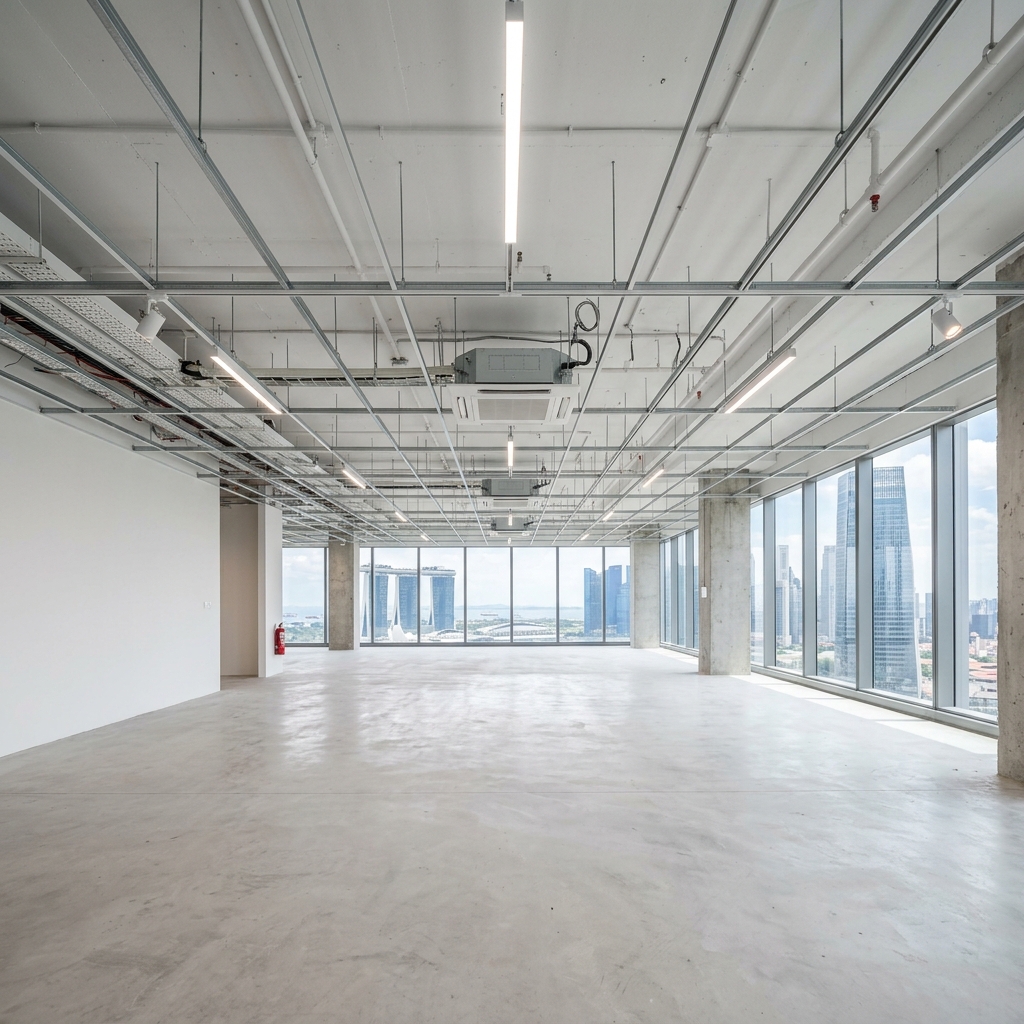
The Ultimate Office Reinstatement Checklist in Singapore (2026)
For corporate tenants and office managers in Singapore, vacating a commercial property is often more stressful than moving in. Beyond the logistics of relocating equipment and staff, you face a strict legal obligation: office reinstatement.
Most commercial tenancy agreements in Singapore contain a standard “reinstatement clause” requiring you to return the premises to the landlord in its original condition—usually a bare-shell state—before the lease officially ends. Failure to meet these landlord requirements can lead to delayed handovers, lease extension penalties, and the forfeiture of your security deposit.
Working with an experienced Reinstatement Contractor is critical. As a BCA Registered Contractor and BizSAFE Level 3 builder, Nouvelle Workz executes office reinstatements directly with in-house building teams, avoiding design-agency markups.
To help you navigate a smooth, dispute-free handover, here is the ultimate checklist for commercial Office Reinstatement Singapore.
—
1. What Does Office Reinstatement Actually Involve?
Many business owners confuse reinstatement with simple demolition. Reinstatement is a highly regulated, technical process of dismantling custom office fittings and restoring the original structural, electrical, and mechanical layout of the building.
Because commercial buildings have central air-conditioning, fire safety grids, and complex power distribution boards, you cannot simply hire general labor to tear down walls. A professional Reinstatement Contractor must coordinate with the building’s MCST (management office) and licensed engineers to terminate utilities safely and prevent building-wide disruptions.
—
2. The Comprehensive Office Reinstatement Checklist
Before handover, verify that your contractor has addressed each of the following areas according to your landlord’s original handover handbook:
A. Partition & Drywall Demolition
- Drywall & Glass Partitions: Fully dismantle all custom meeting room partitions, gypsum board rooms, and executive office glass walls.
- Built-in Carpentry: Demolish custom pantry cabinets, receptionist counters, feature walls, and built-in shelving.
- Doors & Frames: Remove timber or glass doors and their respective metal frames, restoring the original structural openings.
B. Ceiling and Lighting Restoration
- Mineral Fiber Boards: Replace any damaged or missing ceiling grid tiles to ensure a uniform appearance.
- Lighting Grids: Reinstall the landlord’s original T5 or LED modular light fixtures to their original grid coordinates. Remove all custom pendant lights, track lights, and chandeliers installed during your fit-out.
- Ceiling Suspension: Repair and align the ceiling suspension grid lines to prevent sag.
C. M&E (Mechanical & Electrical) Reinstatement
- ACMV Air-Conditioning: Remove all custom flexible ducting and return air-conditioning diffusers and grilles to the landlord’s original layout.
- Power & Data Termination: Safely disconnect and isolate electrical wiring back to the main Distribution Board (DB). Remove custom network cabling (Cat6) and server rack connections.
- Fire Protection (SCDF Compliance): Reset fire sprinkler points and smoke/heat detectors. Drywall partitions block sprinkler coverage, so removing them requires relocating sprinkler heads back to their original spacing to ensure building safety compliance.
D. Flooring and Wall Finishes
- Carpet & Vinyl Removal: Strip away all tenant-installed carpet tiles, vinyl flooring, or raised flooring systems.
- Glue Grinding: Grind off any remaining adhesive or carpet glue on the concrete subfloor to restore the original flat screed finish.
- Wall Painting: Patch all holes from wall-mounted fixtures, sand down the surfaces, and apply two coats of landlord-specified white emulsion paint.
—
3. Managing MCST Permits and Timelines
Reinstatement cannot begin without building management approval. Before commencing work on site:
- Fit-Out/Demolition Permits: Ensure your contractor submits the reinstatement drawings and Method of Statement (MOS) to the MCST for permit approval.
- Work Hours Constraints: Hacking, heavy drilling, and high-noise demolition works must be executed after-hours (typically after 6:00 PM on weekdays or during weekends) to avoid disturbing neighboring corporate tenants.
- Public Liability Insurance: Your contractor must provide a valid public liability insurance policy (typically minimum S$1,000,000 to S$5,000,000 depending on the building) to protect against accidental damage to building common property.
—
Frequently Asked Questions About Singapore Office Reinstatement
How long does a commercial office reinstatement take?
For a standard 2,000 sq ft office in Singapore, reinstatement typically takes 7 to 10 working days, including M&E termination, demolition, paintwork, and final site clearance. Larger spaces or complex corporate reinstatement projects (over 10,000 sq ft) can take 3 to 4 weeks. Always plan to start reinstatement at least 2 weeks before your lease expiry date.
Do I need a Qualified Person (QP) submission for reinstatement?
Generally, restoring a space back to its original approved bare-shell state does not require a new URA or BCA building plan submission. However, if the reinstatement involves modifications to fire sprinkler pipe routes, your contractor must coordinate with the building’s Fire Safety Manager (FSM) and submit testing reports to SCDF.
Can I leave my built-in fixtures if the next tenant wants them?
Only if you obtain written approval from both the landlord and the incoming tenant. This is known as a “mutual covenant” or transfer of fittings. Without a written agreement signed by the landlord, you are legally obligated to reinstate the space completely, regardless of the quality of your fixtures.
—
Skip the Middleman Markups
Planning a commercial space transformation in Singapore? Skip the ID markups. WhatsApp us today to get a direct, transparent contractor quote from the Nouvelle Workz team.