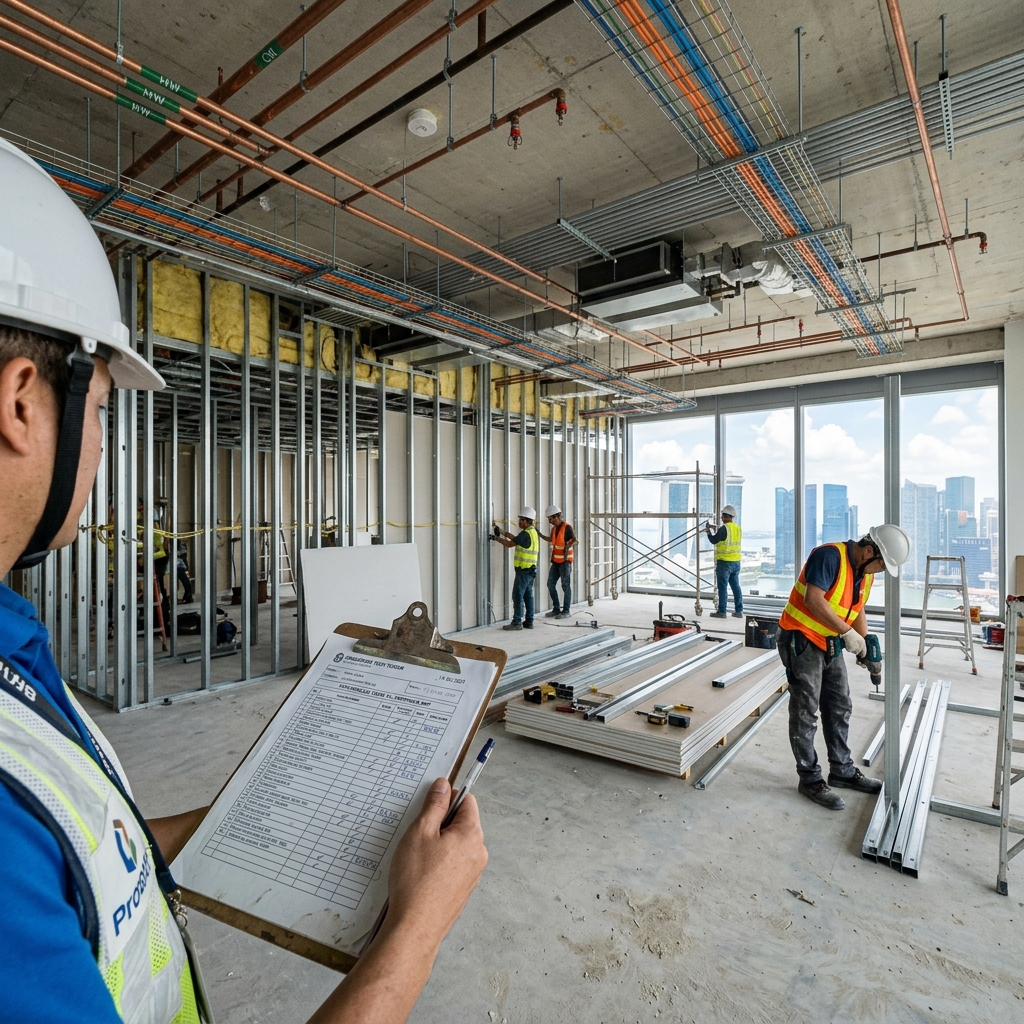
Commercial Renovation Budget Checklist: How to Avoid the Dreaded ‘Variations Order (VO)’ Surprise
For business owners and corporate tenants, executing a commercial fit-out in Singapore is a major financial undertaking. You carefully review bids, select a design or contractor partner, sign the agreement, and expect the project to finish within budget.
Then, mid-way through construction, the “Variations Order (VO)” surprises start piling up.
A Variation Order represents any modification, addition, or deletion of works from the original agreed contract. In Singapore’s fit-out industry, VOs are the single biggest cause of project delays and budget blowouts. While some VOs are genuinely requested by the tenant, a significant portion are the result of poor initial planning, hidden fees, or low-ball bidding tactics.
As a BCA Registered and BizSAFE Level 3 Commercial Contractor Singapore, we believe in absolute cost transparency. In this guide, we reveal how to spot low-bid traps and provide a comprehensive budget checklist to lock in your Office Renovation Singapore cost from day one.
—
1. The Low-Bid Trap: How Budgets Get Inflated
In a competitive market, some interior design (ID) firms use low-ball bidding to win tenders. They submit an attractive initial quote, knowing full well that essential works are omitted.
Once the contract is signed and demolition begins, they issue mandatory VOs for “unforeseen” items that are actually standard construction requirements. Because they outsource the construction works to sub-contractors and lack direct control over building teams, their markups on these VOs are heavily inflated.
Working directly with a direct Commercial Contractor who operates an in-house carpentry factory and employs direct building teams eliminates these middleman markups and ensures a highly accurate, comprehensive initial quotation.
—
2. The Ultimate “No-VO” Commercial Renovation Budget Checklist
To protect your business from surprise costs, ensure your contractor’s quotation explicitly details and includes the following four key categories before you sign the contract:
A. Mechanical & Electrical (M&E) Engineering Details
M&E works typically account for 30% to 50% of a commercial fit-out budget. Check that the quote includes:
- ACMV (Air-Conditioning & Mechanical Ventilation): Relocation and balancing of diffuser grilles, ducting modifications, and SCDF-compliant fresh air supply.
- Fire Protection System: Relocation and testing of fire sprinkler points and heat/smoke detectors to match the new partition layout.
- Electrical Load Assessments: DB (Distribution Board) upgrades and cable trays, not just individual power points.
B. MCST Building Management Requirements
Commercial buildings have strict guidelines. Your budget must cover:
- Refundable Fit-Out Deposits: Who pays and holds the MCST deposit.
- Hoarding & Protection: Building management-approved site hoarding, floor protection sheets along common corridors, and dust control partitions.
- After-Hours Surcharges: Hacking, drilling, and high-noise works must be done after-hours in most Singapore commercial office buildings. Ensure labor rates reflect this.
C. Regulatory & QP Submission Fees
You cannot build commercial partitions or move sprinklers without approvals. Ensure these professional fees are budgeted:
- Qualified Person (QP) & Professional Engineer (PE) Fees: For SCDF (Fire Safety) plan submissions.
- FSSD Inspection and Certificate of FSM (Fire Safety Manager): Verification costs.
D. Material and Joinery Specifications
Vague descriptions like “wooden cabinets” are a breeding ground for VOs. Insist on:
- Specific Material Grades: Exact laminate brands, solid surface brands, and glass thickness (e.g., 10mm tempered glass for office partitions).
- Hardware Brands: Specific soft-close hinges and heavy-duty sliding tracks.
—
3. How to Lock in Your Renovation Budget
- Insist on a Fixed-Price Agreement: Ensure the contract states that the price is locked based on the finalized layout plan, barring any changes explicitly requested by you.
- Do a Thorough Site Survey: A professional builder will conduct a comprehensive site measurement and M&E survey *before* submitting a final quote to identify potential routing issues.
- Partner with a Direct Builder: By bypassing middlemen, you deal directly with the team fabricating your carpentry and executing the wiring, ensuring accountability and preventing VO disputes.
—
Frequently Asked Questions About Commercial VOs in Singapore
Can my landlord (MCST) stop my renovation if a VO is not registered?
Yes. Any variation that alters the approved layout blueprint, changes fire exit pathways, or affects the building’s central M&E system must be updated with the MCST. Unapproved onsite alterations can result in a stop-work order and forfeiture of your fit-out deposit.
Why do fire sprinkler modifications always trigger VOs?
When you add drywall partitions to create meeting rooms or executive offices, you alter the fire boundary. Singapore fire safety code requires every enclosed room to have its own sprinkler coverage and smoke detector. Relocating these pipes requires SCDF QP submissions and SCDF registered inspectors, which contractors often omit from standard design-only quotes.
How do I verify if a contractor has their own carpentry factory?
Ask for the factory address and registration. A direct contractor with in-house fabrication capability can show you active joinery production, ensuring faster lead times and direct factory pricing.
—
Skip the Middleman Markups
Planning a commercial space transformation in Singapore? Skip the ID markups. WhatsApp us today to get a direct, transparent contractor quote from the Nouvelle Workz team.