
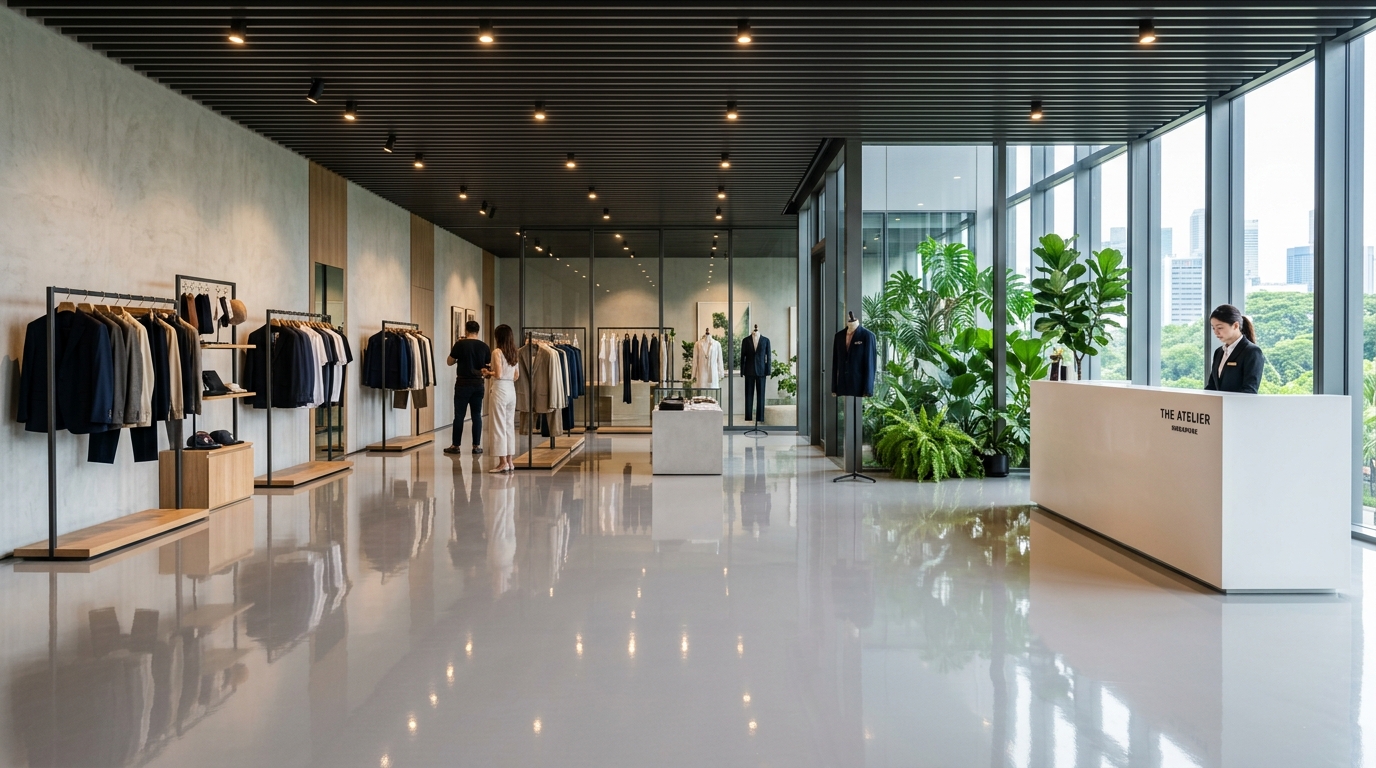
Commercial Epoxy Floor Coating: Complete Guide for Singapore Retail & Industrial Units (2026)
Quick Answer: For commercial retail showrooms, warehouses, and industrial units in Singapore, commercial epoxy floor coating is the gold standard for high-durability, oil-resistant, and low-maintenance flooring. Typically costing between SGD $4.50 to $12.00 per square foot depending on thickness and design, it provides an exceptional return on investment by lasting 15+ years under heavy foot and vehicular traffic.
FTC Disclosure: Nouvelle Workz is a direct commercial flooring and renovation contractor in Singapore. When you consult with our engineering team through our contact links in this guide, you skip ID agent markups and receive direct factory pricing and specialist warranty coverage.
Last updated: July 10, 2026
—
Introduction: The Industrial-Grade Solution for High-Traffic Singapore Spaces
Whether you are managing a high-end retail boutique in Orchard Road, a busy central kitchen in Tai Seng, or a heavy-duty storage warehouse in Tuas, your floor is the most heavily abused surface in your commercial property. Daily foot traffic, rolling carts, forklift tires, oil spills, and chemical washes can rapidly deteriorate standard concrete slabs or traditional floor tiles.
Cracked concrete, stained tiles, and peeling paint are not just aesthetic issues; they represent safety hazards, dust traps, and potential compliance violations under Singapore’s workplace safety guidelines.
This is why commercial floor coating systems—specifically professional-grade epoxy flooring Singapore coatings—have become the industry standard for commercial and industrial spaces. In this guide, we will break down the types of commercial epoxy, detail the critical step-by-step installation process, outline costs, and compare the performance metrics that matter to business owners.
—
1. Understanding Commercial Epoxy Floor Coating Systems
Commercial epoxy is not just “paint.” It is a chemical system consisting of two parts: a liquid polymer resin and a hardener. When mixed, these two components undergo a chemical reaction that creates cross-linked polymer chains. This process transforms the liquid into a rigid, plastic-like solid that binds molecularly to the concrete slab below.
Different spaces require different thicknesses and formulations. Below is a breakdown of the primary commercial coating types.
Core Commercial Epoxy Specifications
| Coating System Type | Typical Thickness | Best Suited For | Key Strength |
|---|---|---|---|
| Thin-Film Epoxy Coat | 0.3mm to 0.5mm | Light-use storage rooms, service yards, offices | Cost-effective, dust-proofing concrete |
| Self-Leveling Epoxy | 2.0mm to 3.0mm | Retail stores, clinics, laboratories, food prep | Completely smooth, glass-like reflection, hygienic |
| Epoxy Mortar System | 4.0mm to 6.0mm | Heavy industrial warehouses, loading docks | Extremely high impact and mechanical resistance |
| Quartz-Broadcast Epoxy | 3.0mm to 4.0mm | Commercial kitchens, food factories, restrooms | Highly slip-resistant, textured, grease-resistant |
—
2. Step-by-Step Installation Process
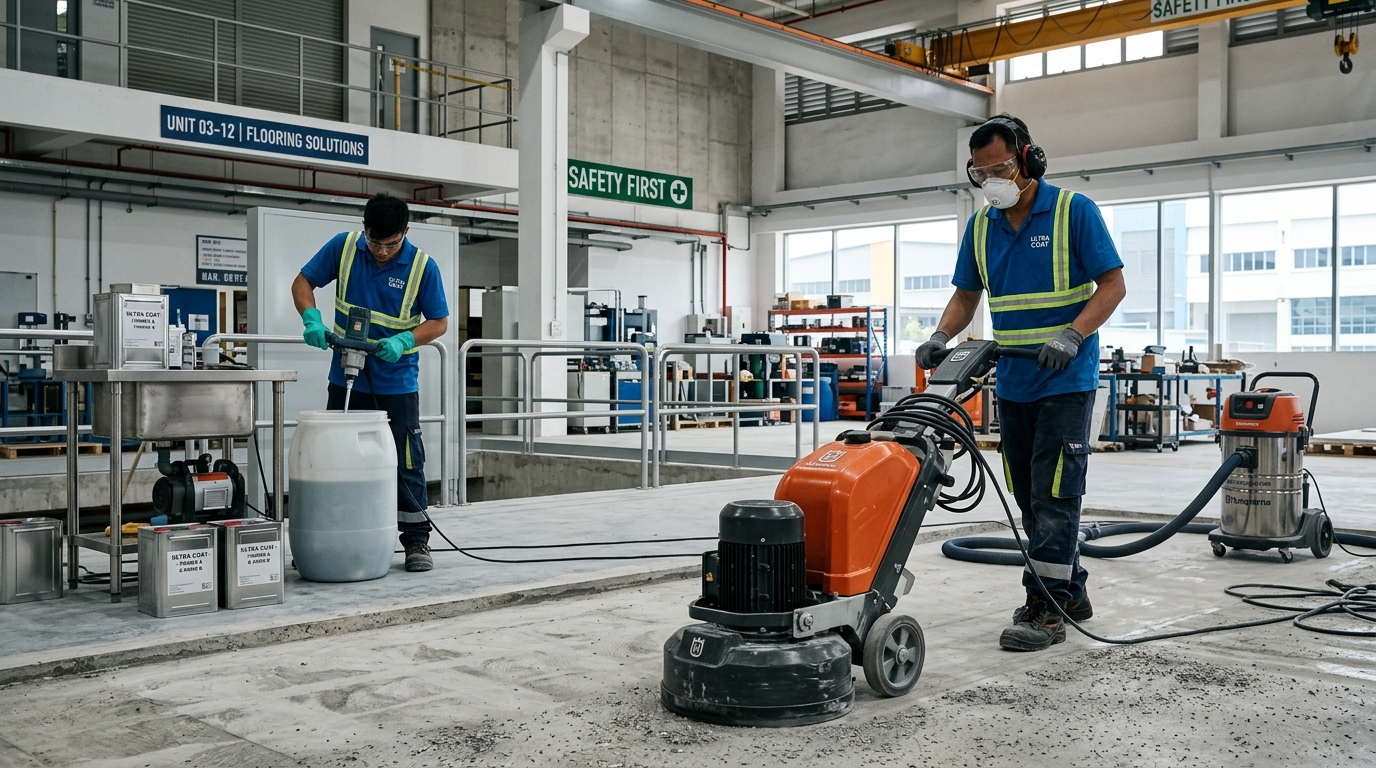
For commercial units, a floor is only as good as its surface preparation. A common failure pattern of DIY or cheap subcontractor installations is skipping crucial prep steps, which causes the epoxy to peel under heavy vehicle tires.
Here is the exact, standard 4-step professional installation process used by certified epoxy floor contractor Singapore teams:
1. Concrete Grinding and Surface Preparation
The concrete slab must be clean, dry, and physically rough to allow the liquid resin to sink into the pores. A heavy-duty walk-behind floor grinder with diamond segment plates is used to grind the concrete surface. This removes old paint, oils, and curing compounds, creating a concrete surface profile (CSP) of 2 or 3 (similar to medium sandpaper). All cracks, pits, and expansion joints are then filled with high-strength epoxy patch filler and ground flat.2. Moisture Barrier and Primer Application
Concrete is naturally porous and contains moisture. If not sealed, vapor pressure from under the slab will rise, causing bubbles and blisters in the finished epoxy. A specialized moisture-tolerant epoxy primer is applied. This layer penetrates deep into the concrete pores, creating a molecular bond and forming a watertight seal that blocks rising dampness.3. Epoxy Body Coat and Design Layer
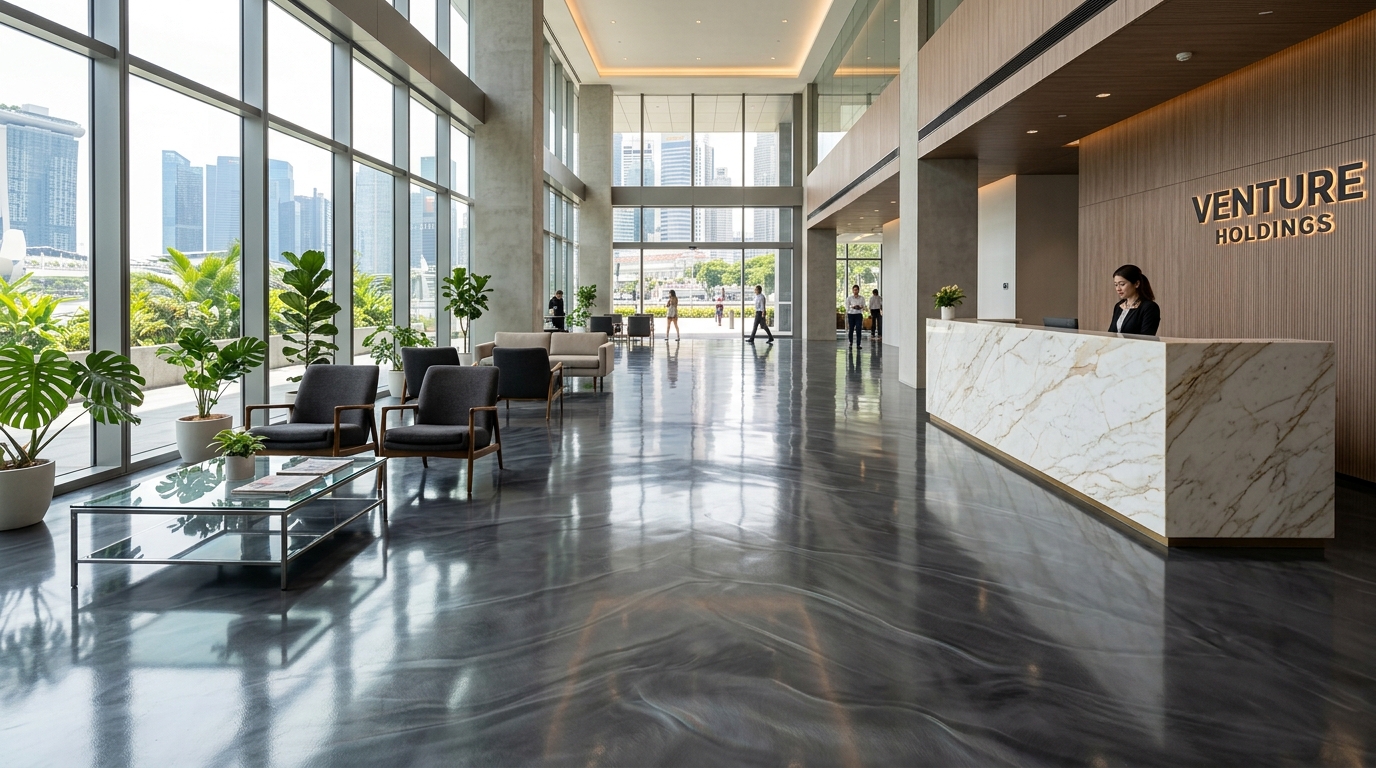
Once the primer has cured, the primary load-bearing epoxy body coat is applied. For industrial units, this is a solid color (usually dark gray or green). For retail spaces, this is the stage where metallic pigments or color flakes are swirled into the wet resin to create a custom marble or granite design. This layer provides the physical thickness, chemical resistance, and base color of the floor.4. Industrial Polyurethane/Polyaspartic Sealer
The final step is the application of a high-performance protective sealer. While epoxy provides excellent strength and adhesion, it can scratch under heavy friction and fade under direct UV sun exposure. A clear polyurethane or polyaspartic topcoat is applied to act as a shield. Slip-resistant aggregates (like glass spheres or aluminum oxide) are broadcast into this final coat to provide high traction in wet or greasy conditions.—
3. In-Depth Benefits of Commercial Epoxy Flooring
Choosing a floor coating for a business is a balance of operational efficiency and safety. Here are the core business reasons why commercial epoxy is selected over tiles or polished concrete:
Operational Durability and Longevity
In industrial warehouses, rolling equipment and forklifts exert high point loads. Epoxy coatings distribute these loads evenly across the concrete slab. High-build epoxy systems can withstand compression loads up to 10,000 PSI—nearly three times the strength of standard concrete alone. This prevents concrete dusting, pitting, and cracking, protecting your structural slab from long-term wear.
Seamless Hygiene and Cleanliness
Under Singapore’s NEA (National Environment Agency) and SFA (Singapore Food Agency) guidelines, commercial kitchens, food manufacturing plants, and medical clinics must maintain strict sanitation standards.
Traditional tiled floors have grout lines that naturally trap moisture, bacteria, dirt, and mold. Epoxy creates a completely seamless, monolithic surface from wall to wall. It can also be applied with “coving” (where the floor curves up the wall by 100mm), eliminating the right-angle corner joint where dirt collects, allowing for fast washdowns and sanitation.
High Slip Resistance and Workplace Safety
Slip-and-fall accidents are a major liability for businesses. Commercial kitchens, garages, and packaging lines are prone to water, oil, and dust spills. By custom-blending slip-resistant aggregates into the topcoat, contractors can adjust the floor’s coefficient of friction (CoF) to meet specific workplace safety standards. This ensures safety without compromising cleanability.
—
4. Budgeting and Price Breakdown
Understanding the pricing structure helps commercial tenants allocate their capital expenditure during shop fit-outs.
The typical epoxy coating price Singapore ranges from SGD $4.50 to $12.00 per square foot for commercial and industrial units. Small shops under 500 sq ft usually have a flat rate or higher unit costs (approx. SGD $9.00 – $14.00/sq ft) due to equipment mobilization. Larger spaces over 2,000 sq ft benefit from economies of scale, with prices ranging from SGD $4.50 to $7.50/sq ft. Single-tone industrial coatings are cheaper than custom metallic retail coatings.
Commercial & Industrial Epoxy Price Guide
Below is an average cost matrix for commercial applications in Singapore:
| Project Area Size | 1.0mm Single-Tone Epoxy (Commercial Office/Storage) | 2.0mm Self-Leveling Epoxy (Retail/Clinic/Laboratory) | 3.0mm Non-Slip Quartz (Commercial Kitchen/Factory) |
|---|---|---|---|
| Small Units (< 500 sq ft) | SGD $10.00 – $12.00/sq ft | SGD $12.50 – $15.00/sq ft | SGD $14.00 – $18.00/sq ft |
| Medium Units (500 – 1,500 sq ft) | SGD $7.50 – $9.50/sq ft | SGD $9.50 – $12.00/sq ft | SGD $11.00 – $13.50/sq ft |
| Large Units (1,500 – 5,000 sq ft) | SGD $5.50 – $7.00/sq ft | SGD $7.50 – $9.50/sq ft | SGD $8.50 – $10.50/sq ft |
| Industrial / Warehouses (> 5,000 sq ft) | SGD $4.00 – $5.50/sq ft | SGD $5.50 – $7.00/sq ft | SGD $6.50 – $8.50/sq ft |
Note: All prices are estimates including standard surface grinding and crack filling. Custom color matching, stencil logo integration, and fast-cure polyaspartic upgrades (for overnight fit-outs) may incur additional costs.
—
5. Choosing the Right Contractor: B2B Project Management
For businesses, time is money. A delayed renovation project directly translates to lost revenue. If your retail shop cannot open on schedule because the floor hasn’t cured or the contractor made a mistake, it costs you lease rent and sales.
Hiring a general renovation agency or ID often results in communication lag. Because floor preparation requires specialized machinery (diamond grinders, dust extractors) and precise chemical mixing, general subcontractors often cut corners on concrete moisture testing, leading to floor peeling after six months.
By partnering with a direct B2B commercial flooring specialist like Nouvelle Workz, you ensure:
- Fast Turnaround Time: We operate our own concrete prep machinery and have dedicated commercial teams, allowing us to hit tight renovation schedules without delay.
- Industrial-Grade Products: We use commercial-grade resins with high solids content and UV-stable polyurethane topcoats, ensuring long-term color retention and wear resistance.
- NEA/SFA Compliance Support: We design food-grade coving and textured slip-resistant surfaces that meet local hygiene and safety standards, helping you secure operating licenses smoothly.
—
FAQ
How long does commercial epoxy floor coating take to install and dry?
A standard commercial installation takes between 3 to 5 days, depending on the number of layers and repairs needed. For businesses that cannot afford downtime, we offer fast-cure polyaspartic coatings that cure within 4 to 8 hours. This allows us to grind, coat, and return the floor to service over a single weekend or night shift.
What is the difference between residential and commercial epoxy flooring?
Residential epoxy (like HDB bathrooms) focuses heavily on aesthetic designs, metallic swirls, and thin-film comfort. Commercial and industrial epoxy focuses on thickness, impact resistance, heavy compression limits, chemical resistance to acids and hot oils, and precise slip-resistance ratings.
Can commercial epoxy be installed over damaged concrete?
Yes. During the preparation stage, our teams use heavy grinders to clean the slab, then use epoxy polymer mortar to patch cracks, spalls, and holes. Once the patches cure, we grind the entire surface flat before applying the primer, creating a smooth, level finish over uneven subfloors.
How do I maintain a commercial epoxy floor in a high-traffic retail store?
Maintenance is incredibly simple. For daily cleaning, sweep or dust-mop the floor to remove grit. For washing, use a microfiber mop or automatic scrubber with a mild, pH-neutral commercial floor cleaner. Avoid using high-concentration acids or solvent-based cleaners, which can dull the protective topcoat.
—
Final Thoughts: The Solid Foundation for Your Business
A commercial floor is a long-term business asset. Investing in a professional-grade commercial epoxy coating ensures that your retail showroom, commercial kitchen, or industrial unit remains safe, clean, and operations-ready for decades.
If you want to protect your property investment and avoid subcontractor markups, consult with our engineering team today.
Need an industrial-strength floor coating for your commercial unit? Contact Us