
Condo bathroom renovation in Singapore is the comprehensive remodeling and waterproofing process of upgrading private apartment toilets, involving full demolition of existing wall and floor tiles, subfloor cement screeding, installation of certified liquid-applied waterproofing membranes, replacement of concealed sanitary plumbing, and mounting modern sanitary wares under strict MCST estate bylaws.
- Average Cost per Bathroom: $8,900 – $14,200 for full hacking, waterproofing, tiling, and sanitary fit-out.
- MCST Renovation Deposit: Typically $1,000 – $3,000 (fully refundable subject to zero common area damage).
- Mandatory Waterproofing Inspection: Minimum 48-hour water ponding test witnessed and signed off by the condominium estate management.
- Standard Duration: 2 to 3 weeks per bathroom executed by licensed wet-trade specialists.
Renovating a private condominium bathroom in Singapore involves significantly more stringent management compliance, technical coordination, and risk management than an HDB flat overhaul. While public housing renovations operate under standard HDB renovation portal guidelines, condominium units are governed by private Management Corporation Strata Title (MCST) bylaws. From security deposits running up to $3,000 to strict limits on hacking hours and mandatory 48-hour water ponding tests, navigating a condo bathroom remodel demands an experienced, BCA-registered contractor.
Whether you are updating an aging 15-year-old development to rectify hairline floor leaks or transforming a builder-grade master bathroom into a luxury spa sanctuary, understanding the itemized costs, technical trades, and approval milestones will ensure your project finishes on time without forfeiting your deposit.
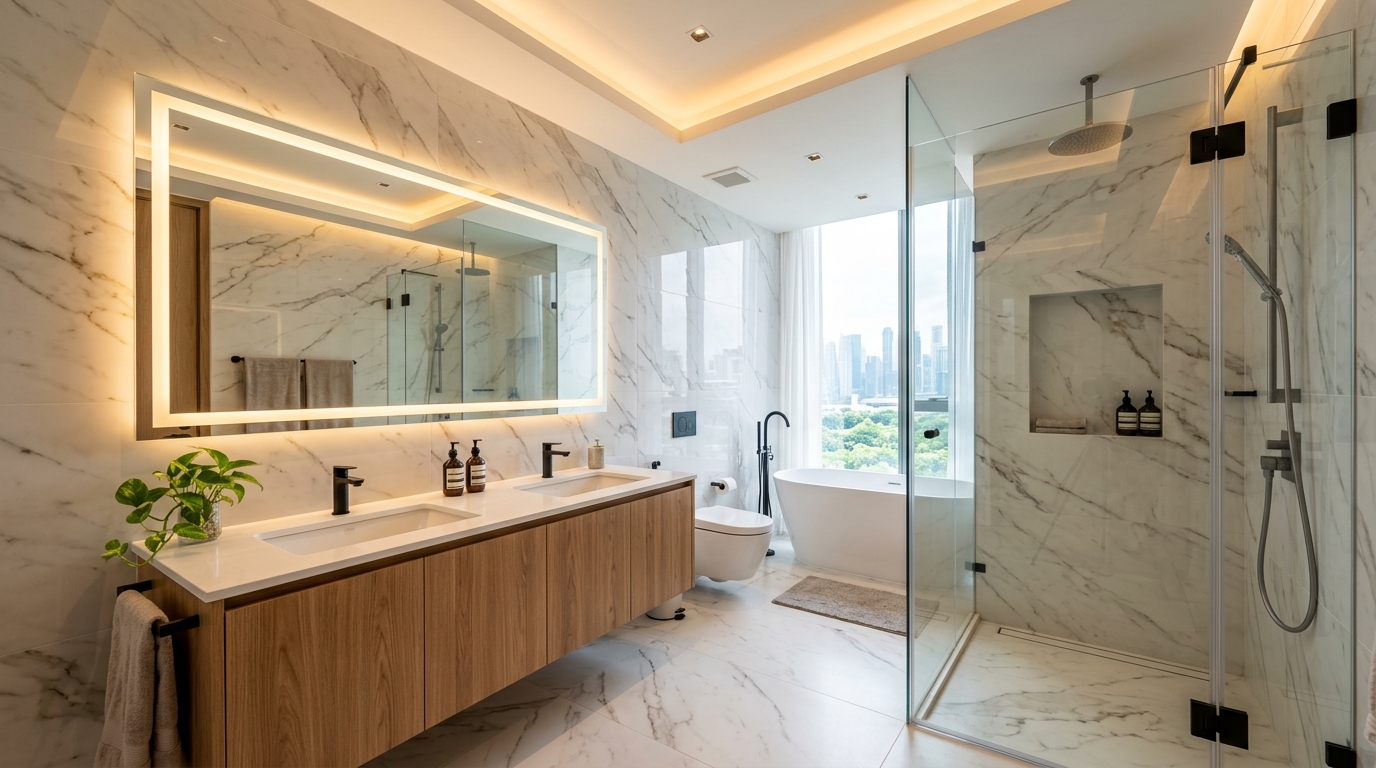
How Condo Bathroom Renovation Differs From HDB Flats
Many homeowners make the mistake of applying HDB renovation assumptions to condominium bathrooms. While HDB flats impose a 3-year restriction on hacking bathroom floor tiles for new BTO flats and require pre-packed cement screed subsidies, condominiums introduce unique private property constraints:
- MCST Renovation Deposits & Approvals: Every condominium management requires a formal permit submission prior to commencing work. Homeowners or contractors must submit an official Renovation Undertaking Form, Public Liability Insurance (minimum $1,000,000 coverage), and lodge a refundable deposit ranging from $1,000 to $3,000.
- Restricted Heavy Hacking Windows: Unlike HDB flats where noisy works are permitted on weekday mornings and afternoons up to 5:00 PM, many luxury condominiums restrict noisy hacking strictly between 9:00 AM and 1:00 PM or 2:00 PM to 4:00 PM on weekdays only, with a zero-tolerance ban on Saturdays, Sundays, and Public Holidays.
- Mandatory 48-Hour Water Ponding Test: Before laying floor tiles, the condominium building maintenance supervisor must personally inspect the bathroom floor filled with water for a continuous 48-hour period to guarantee zero inter-floor seepage into the unit below.
- Strict Common Property Protection: Elevator interiors, hallway carpets, and lobby marble must be thoroughly protected with heavy-duty corrugated plastic boards and canvas sheets throughout the material transfer and debris removal phases.
2026 Condo Bathroom Renovation Cost Breakdown in Singapore
Condominium bathroom remodeling costs depend on the level of intervention: a cosmetic overlay, a partial refresh, or a complete back-to-concrete hacking overhaul. In 2026, labor and material costs reflect updated BCA material standards and BCA-certified trade wages.
Below is the realistic 2026 market pricing for a complete condominium bathroom overhaul executed by a direct licensed contractor:
| Work Scope & Trade Item | Specifications & Inclusions | 2026 Direct Contractor Rate | Interior Design (ID) Markup |
|---|---|---|---|
| 1. Protection & MCST Hoarding | Lift lobby protection, lift padding, canvas corridor floor lining | $500 – $800 | $900 – $1,400 |
| 2. Complete Demolition & Hacking | Hack wall/floor tiles to bare slab, remove vanity, bathtub, screen & haulage | $1,600 – $2,400 | $2,400 – $3,500 |
| 3. Subfloor Screeding & Rendering | Apply pre-packed cement screed to walls and create proper floor drainage gradient | $1,400 – $1,900 | $1,900 – $2,600 |
| 4. Multi-Layer Waterproofing Membrane | 3-coat polyurethane/polymer modified membrane + 48-hr MCST ponding test | $900 – $1,400 | $1,500 – $2,200 |
| 5. Wall & Floor Tiling (Supply & Lay) | Large-format 60x120cm porcelain or homogeneous tiles + anti-mold epoxy grout | $2,800 – $4,200 | $3,800 – $5,800 |
| 6. Concealed Plumbing Replacement | Replace concealed copper cold/hot pipes with PPR/stainless steel to PUB standards | $1,100 – $1,800 | $1,600 – $2,500 |
| 7. Sanitary Ware & Glass Installation | Install wall-hung WC, 10mm tempered glass shower screen, basin, mixer & rain shower | $800 – $1,500 | $1,200 – $2,200 |
| Estimated Total (1 Bathroom) | Turnkey demolition to handover | $9,100 – $14,000 | $13,300 – $20,200 |
By engaging a direct builder like Nouvelle Workz rather than an interior design middleman, homeowners typically save between $4,000 and $7,000 across a 2-bathroom condominium renovation. Learn more about our factory-direct wet trades on our dedicated Plumbing and Sanitary Works Service page.
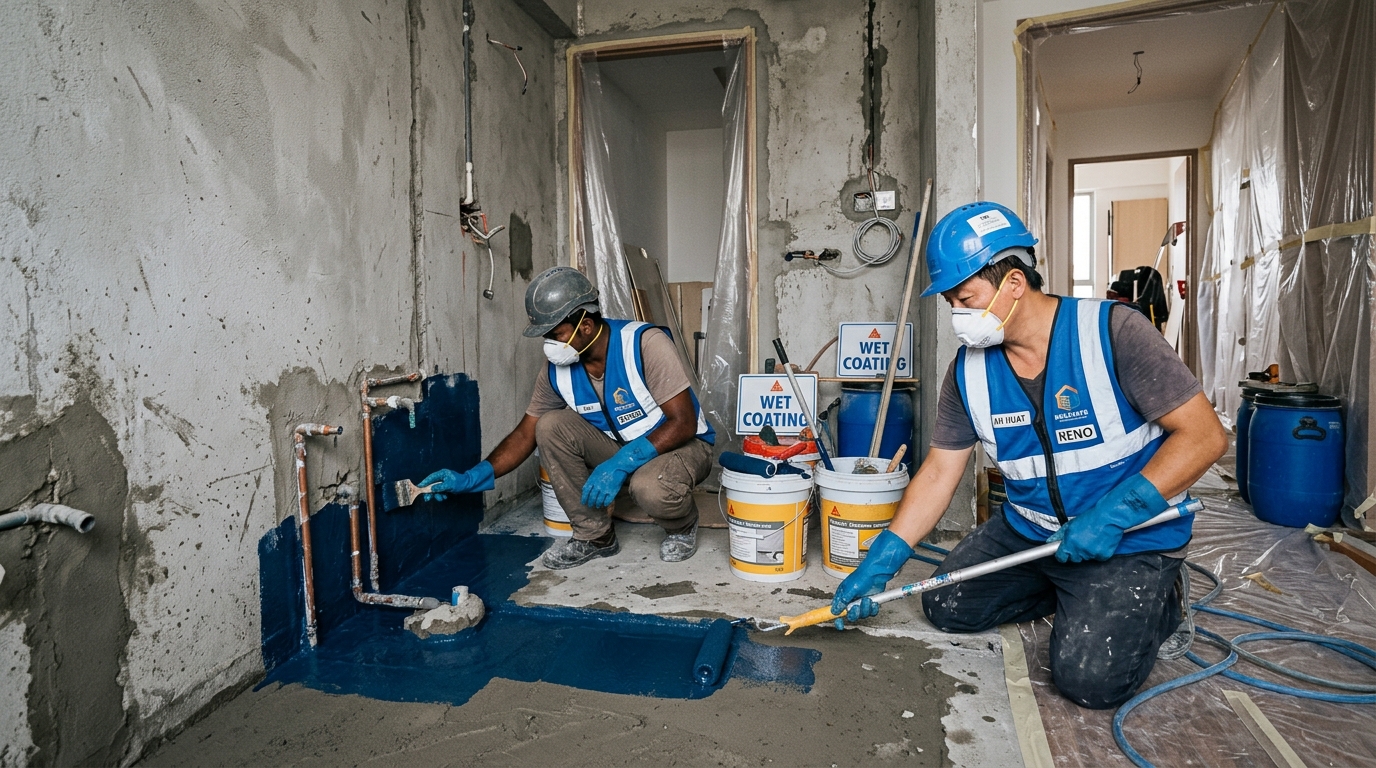
Step-by-Step Technical Process: From Hacking to Ponding Test
Phase 1: MCST Filing & Common Area Protection (Day 1)
Work cannot start until the building management approves the permit. On the morning of day 1, our crew lays protective floor sheeting from the condo service lift to the unit entrance door. Debris bags are staged neatly to comply with condominium disposal rules.
Phase 2: Complete Wall & Floor Tile Hacking (Days 2 to 4)
Existing wall tiles, floor finishes, sanitary fixtures, and false ceilings are stripped away. In older condominiums (over 15 years old), old concealed copper piping is inspected for galvanic corrosion or pinhole leaks before being completely decommissioned.
Phase 3: Concealed Piping & Pre-Packed Screeding (Days 5 to 7)
New stainless steel or high-density PPR hot and cold water pipes are routed through wall chases to PUB code. Masonry specialists then apply high-strength cement screed to the walls and cast a subfloor with a calibrated fall gradient towards the floor trap to avoid water pooling.
Phase 4: Waterproofing Membrane & 48-Hour Ponding Test (Days 8 to 11)
This is the most critical milestone of the entire renovation. Three coats of premium elastomeric waterproofing membrane (such as SikaTop Seal-107 or Davco K11) are applied over the cured screed, upturned at least 300mm onto the walls and fully up to ceiling height within the shower area. Once cured, the bathroom floor is plugged and filled with water for a continuous 48-hour ponding test. The condo building manager or property officer conducts an official inspection of the unit below before signing off.
Phase 5: Tile Laying & Waterproof Epoxy Grouting (Days 12 to 16)
Once the ponding test is signed off, floor and wall tiles are laid using polymer-modified adhesive. To prevent dark mildew and soap scum accumulation, our team recommends stain-resistant, 100% waterproof Epoxy Grout Services for wet shower floors.
Phase 6: Sanitary Fit-Out & Final Handover (Days 17 to 20)
Custom bathroom vanity counters, wall-hung WC bowls, thermostatic mixers, rain showers, and 10mm tempered glass screens are installed. The MCST officer performs a final inspection to confirm no common property damage, releasing your renovation deposit in full.
“In private condominiums, water seepage into the unit below is the single most contentious defect. Most MCST bylaws require a mandatory 48-hour water ponding test witnessed by the estate manager before any tile laying. Engaging a direct builder who understands MCST deposit refund criteria protects both your living comfort and your $2,000 security deposit.”
— James Liang, Founder & Managing Director of Nouvelle Workz Pte. Ltd.
Tile Overlay vs Full Hacking for Condo Bathrooms: Which Is Right for You?
A frequent question from condominium owners is whether they can save money by overlaying new vinyl or thin tiles over existing bathroom floors. While tile overlaying can save approximately $1,800 to $2,500 in hacking and waterproofing costs, there are critical considerations:
- When Overlay Works: The existing bathroom is structurally sound, has zero history of water seepage into the ceiling below, and the floor gradient allows for an extra 10mm to 15mm of tile height without obstructing the bathroom door curb.
- When Full Hacking Is Mandatory: If your condominium is older than 12 years, exhibits hollow tiles, or your downstairs neighbor has ever reported discolored ceiling patches, overlaying will merely conceal an active leak. Trapped moisture will deteriorate concrete rebars, leading to costly spalling concrete repairs down the road.
Why Choose Nouvelle Workz for Your Condominium Renovation
As a direct builder holding a BCA Registered Contractor licence, HDB licence (HB-075810E), and bizSAFE Level 3 certification, Nouvelle Workz executes private residential renovations with factory-direct pricing and in-house trade supervision:
- Direct Contractor Pricing: Save 15% to 30% by cutting out commercial sales designers and middleman subcontracting fees.
- Complete MCST Permit Handling: We handle insurance certificates, risk assessments, and property manager coordination from start to handover.
- Transparent Project Milestone Billing: Progressive payments tied to completed works, with clear contractual scopes and zero hidden variation orders. Minimum project commitment of $3,000 ensures dedicated attention to comprehensive overhauls.
- Integrated Commercial and Residential Capabilities: Beyond luxury residential makeovers, our teams also handle high-stakes Commercial Reinstatement and Office Handover Services across Grade A commercial and retail assets.
Planning a Condo Bathroom Remodel in Singapore?
Explore our licensed Plumbing & Sanitary Services, or inspect our past residential work in our Project Portfolio.
Speak directly with our project managers for a transparent, itemized quotation with zero middleman markup.
Frequently Asked Questions
How much does a full condo bathroom renovation cost in Singapore?
In 2026, a complete condominium bathroom overhaul typically costs between $8,900 and $14,200 per bathroom when engaging a direct licensed contractor. This includes preliminary common area protection, tile hacking, subfloor screeding, 3-coat waterproofing membrane, 48-hour MCST water ponding test, large-format tiling, concealed plumbing replacements, and mounting sanitary wares.
How long does a condo bathroom renovation take to complete?
A standard condo bathroom renovation requires approximately 2 to 3 weeks per bathroom. The duration is dictated by the mandatory curing time for subfloor cement screed (3 to 5 days), the mandatory 48-hour MCST water ponding test, and restricted condominium hacking hours that permit noisy works only during limited weekday morning and afternoon windows.
What permits are needed from the MCST before renovating a condo bathroom?
Before starting, homeowners must lodge an official Renovation Permit Application with their condo management office, submit contractor Public Liability Insurance ($1,000,000 coverage), provide an itemized schedule of noisy hacking dates, and pay a refundable security deposit between $1,000 and $3,000 to cover potential common area damages.
Can I hack down a wall between two condo bathrooms?
Non-structural partition walls can be removed or altered with MCST approval. However, structural reinforced concrete (RC) columns, structural shear walls, and building service duct shafts (containing vertical plumbing and vent stacks) are strictly prohibited from being hacked. If removing a thick masonry partition, the MCST may request a Professional Engineer (PE) structural endorsement.